
 EN

How to Compare Custom Tube Packaging Quotes from Suppliers
When several suppliers answer the same RFQ, custom tube packaging can look easier to buy than it is. One quote may show a lower unit price, while another quietly includes artwork preparation, a different wall structure, a cap option, or a more workable approval process. For a cosmetics or personal-care procurement team, the useful question is not “Which offer has the lowest quoted price?” It is “Which custom tube packaging offer describes the same deliverable, at the same volume, with conditions we can verify?”
As a procurement evaluator, start with a common specification sheet before you compare numbers. This is particularly important for plastic tube packaging: the formula, filling line, dispensing expectation, visual brief, and distribution route all affect what the quote should include. A quote comparison becomes much clearer when every supplier responds to the same fields.
Build a like-for-like custom tube packaging quote sheet
Do not compare a single price column. Ask each supplier to complete the same quote sheet and state any assumptions beside each item. The table below is a practical starting point for custom tube packaging procurement.
| Field to compare | What to request | Why it changes the quote |
|---|---|---|
| Tube format | Material, diameter, length, target fill volume, shoulder and cap style | Similar-looking tubes may not use the same structure or closure. |
| Decoration | Print colors, finish, print area, artwork revision rules, and proof approval | A lower price may cover a different print scope. |
| Order basis | MOQ, quoted volume tiers, unit price by tier, and overrun/underrun terms | Unit costs only make sense against the same quantity. |
| One-time charges | Tooling, plate, setup, sample, or artwork-related charges | These costs can change the first-order total substantially. |
| Validation and delivery | Sample stage, acceptance points, production lead time, packing, shipment terms | A fast-looking quote may omit a needed approval step. |
For custom tube packaging, put the agreed currency, Incoterm, quote validity period, and tax or freight treatment at the top of the sheet. If a supplier does not state an assumption, mark the cell “not confirmed” rather than filling it in yourself.
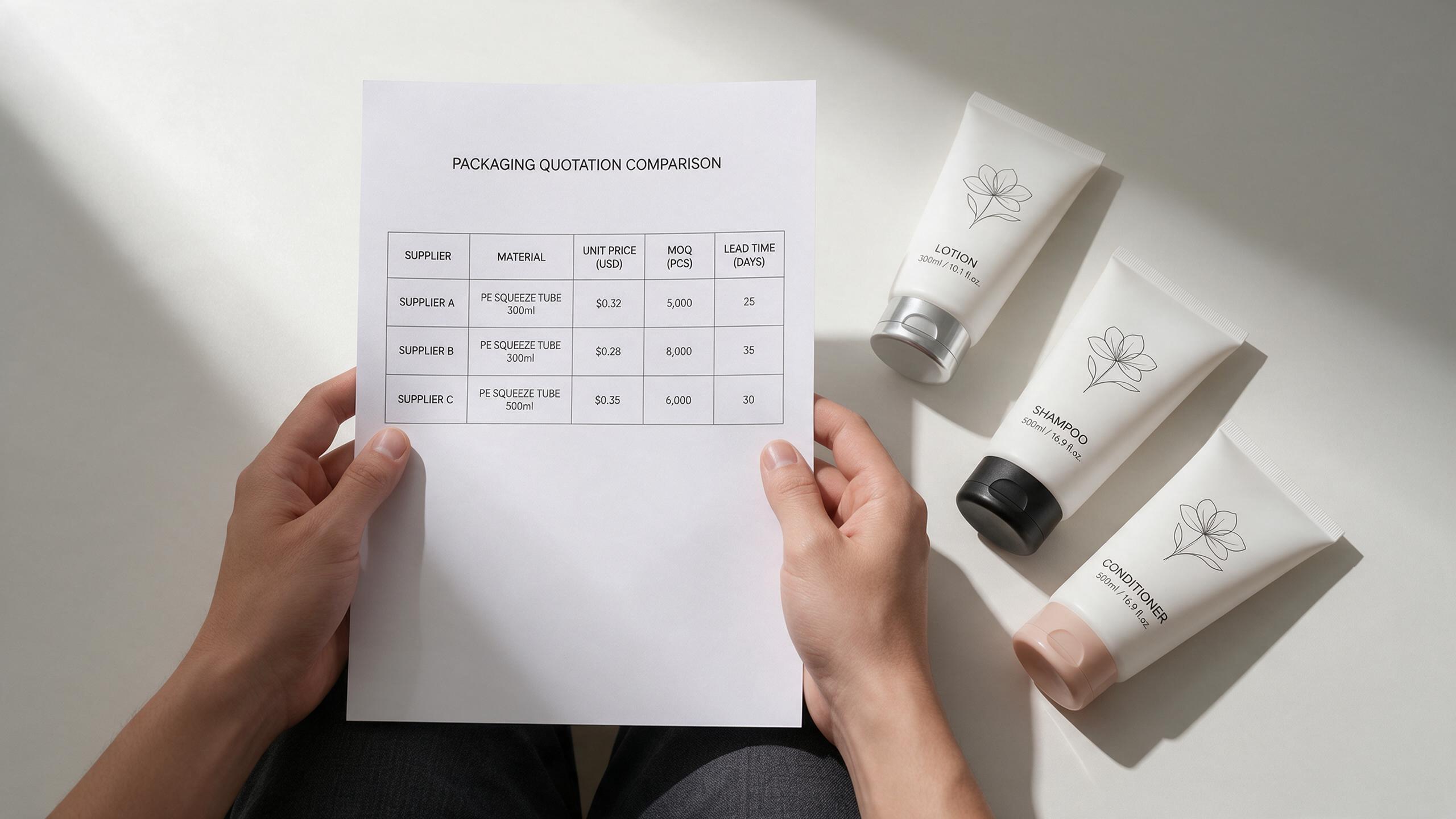
Check the physical specification before the price
The first comparison pass for custom tube packaging should test whether each supplier is pricing the same physical item. Record tube material, layers if relevant, diameter, length, nominal fill volume, shoulder shape, cap type, and sealing arrangement. Ask whether the requested volume is a nominal tube capacity or a recommended fill level; those may not be interchangeable.
Then connect the specification to the product and process. A tube that works visually may still need review against the formulation, filling method, viscosity, dispensing behavior, and expected handling. That does not mean a buyer should assume a tube is unsuitable. It means the quote should identify what the supplier priced and what still requires sample confirmation. If packaging appearance is the priority, confirm the required finish first; however, the formula and filling process still need to be checked.
For a product example, the confirmed site listing for custom empty squeeze packaging in 15–60 ml PE tubes can help a team frame questions about capacity range and intended cosmetic applications. It should not replace a project-specific specification or sample review.
Separate decoration, tooling, and sample costs
Decoration is often where custom tube packaging quotes stop being comparable. Ask for the print process, number of colors, finish, print area, artwork file requirements, proof format, and the number of revision rounds included. If a supplier writes “custom printing” without details, request clarification before ranking the quotation.
Next, list non-recurring and conditional costs separately. Tooling or mold charges may apply when dimensions or components are not standard; plate, setup, and sample charges may have different payment and credit terms. A credible custom tube packaging offer should make it possible to calculate both the first-order landed package cost and the repeat-order cost. Do not blend one-time charges into the unit price without a note, because doing so hides the trade-off between an initial order and a future replenishment.
Compare samples as a decision gate, not as a formality. Confirm whether the supplier will provide a visual proof, a blank structural sample, a decorated sample, or a production-representative sample. Also record who approves it, what constitutes an acceptable revision, and whether that approval affects the production schedule.
Evaluate MOQ, pricing tiers, and total purchase cost
A lower MOQ can be useful for a launch, but it may carry a different unit cost or decoration limitation. Put each supplier’s MOQ beside the volume tiers they quoted, then calculate the extended value at the quantities your business is actually likely to buy. For custom tube packaging, add unit price, one-time charges, packing, inspection or sampling charges, and freight treatment in separate columns.
It is tempting to choose the lowest ex-works number. A better approach is to flag cost items that remain unknown and compare each offer on three views: first-order total, repeat-order total, and cost per usable approved tube. The last view prompts a useful discussion about approval conditions, documented specifications, and avoidable rework without claiming that any supplier will deliver a particular outcome.
Compare lead time and commercial conditions
For custom tube packaging, ask suppliers to split their timing into artwork confirmation, sampling, sample approval, production, and dispatch. A single “lead time” number can hide the point at which the clock starts. Record the date assumptions and the buyer actions required to keep the schedule moving.
Commercial conditions deserve the same attention. Compare payment milestones, quote expiry, packaging method, quality-claim window, shipment terms, and the treatment of changes after artwork approval. When a supplier offers a shorter schedule, ask what is included in that schedule and which approvals remain the buyer’s responsibility.
Use a weighted decision, then close the open questions
Once the custom tube packaging offers are aligned, score them against criteria your project actually values: specification fit, sample plan, decoration clarity, MOQ fit, first-order total, repeat-order total, lead-time transparency, and communication quality. Weighting is more useful than a universal ranking. A new skincare launch may place more weight on sample and decoration review, while a recurring program may emphasize repeat-order economics and specification consistency.
Before issuing a purchase order, send each finalist the same short clarification list. Confirm the tube specification, artwork and proof path, quoted tier, one-time charges, sample type, acceptance criteria, production start point, delivery terms, and exclusions. That final check turns custom tube packaging quotes into a documented procurement decision instead of a price-only comparison.
Baolilai works with B2B buyers discussing plastic tube packaging, printing, and size requirements. Share the same specification sheet with every supplier, then use samples and written clarifications to decide which proposal fits your project conditions.